This was my first time voting, and it was incredible.
Voting Process
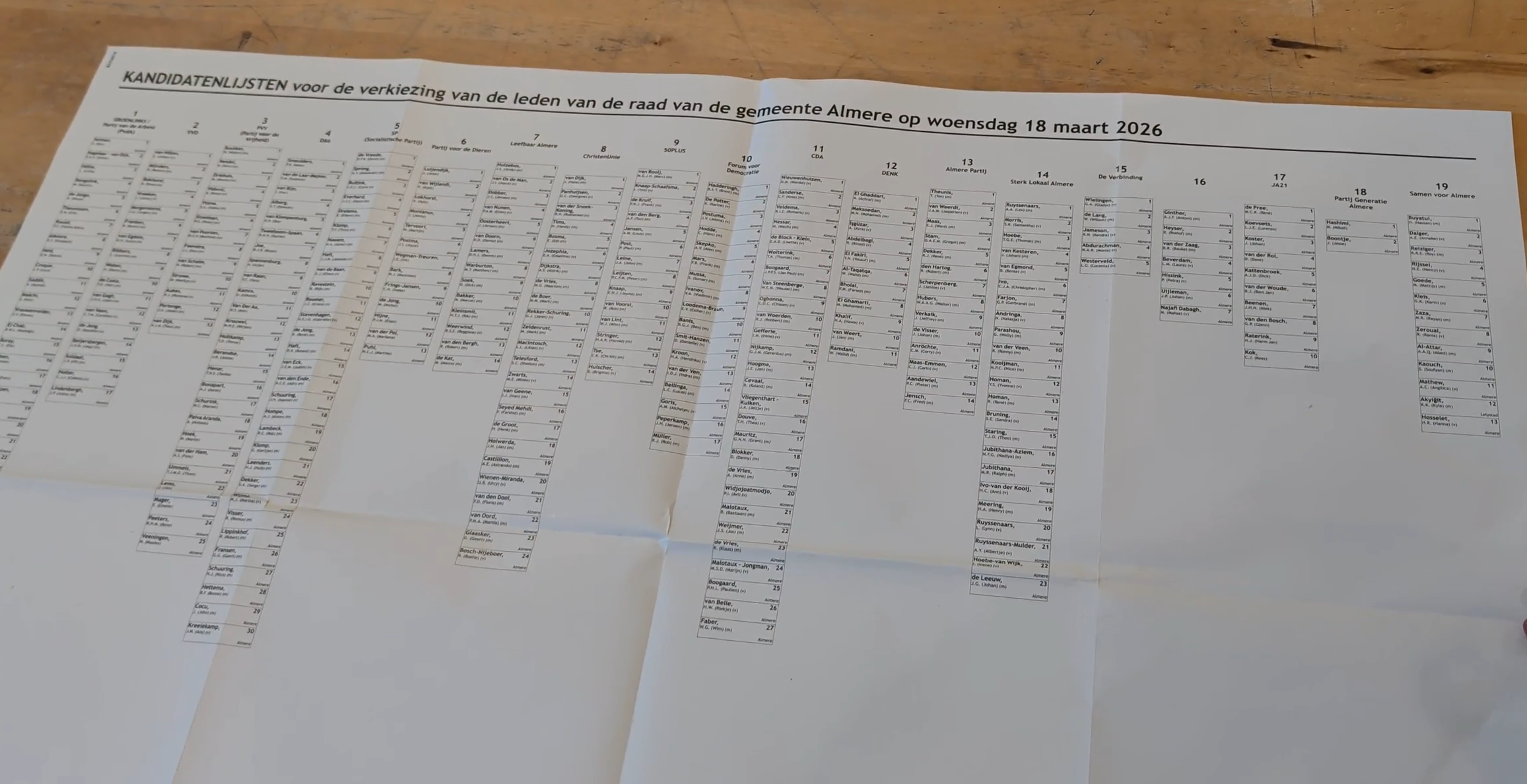
The ballot paper for the Almere council elections.
I am a Pakistani, and I do not hold a Dutch citizenship. And as per the laws, non-Dutch citizens are allowed, and invited to vote for the local municipal (council) elections. The rules are clear and simple, for non-Dutch citizens, adults who have lived legally for the last 5 years can vote.
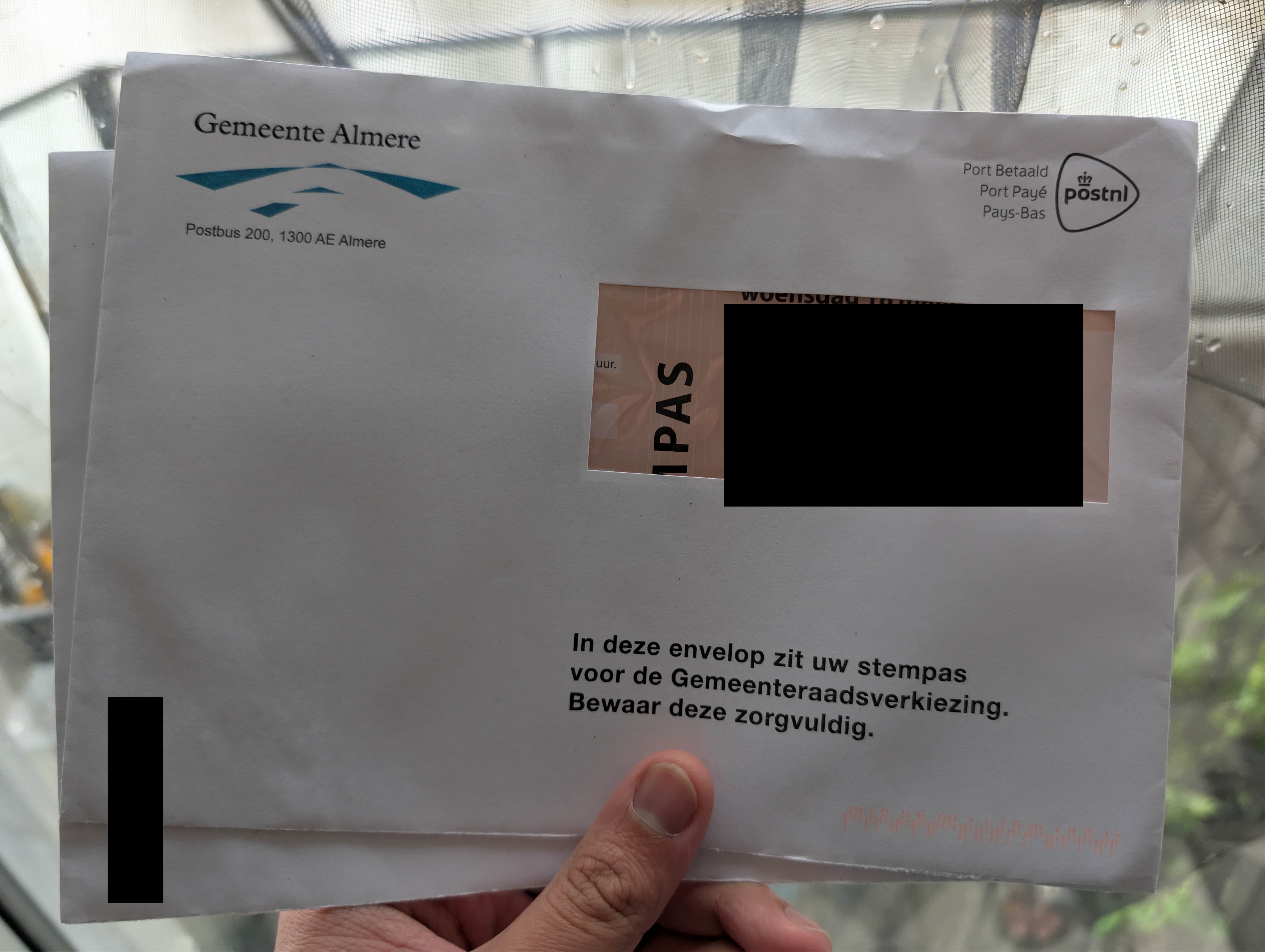
The invite is a voting pass that you receive, and if you are multiple people living at the address who qualify for the invite you will receive multiple invite passes.
The invite passes arrive to your home address a few weeks before the elections. If you do not receive a pass, or if you lose it, you should request a new pass from your municipality.
The election took place on Wednesday 18th March, 2026. The polling stations are open from morning until late at night (9pm in most cases). I visited the polling station after office, so about 6pm and it was a very simple and straight-forward procedure.
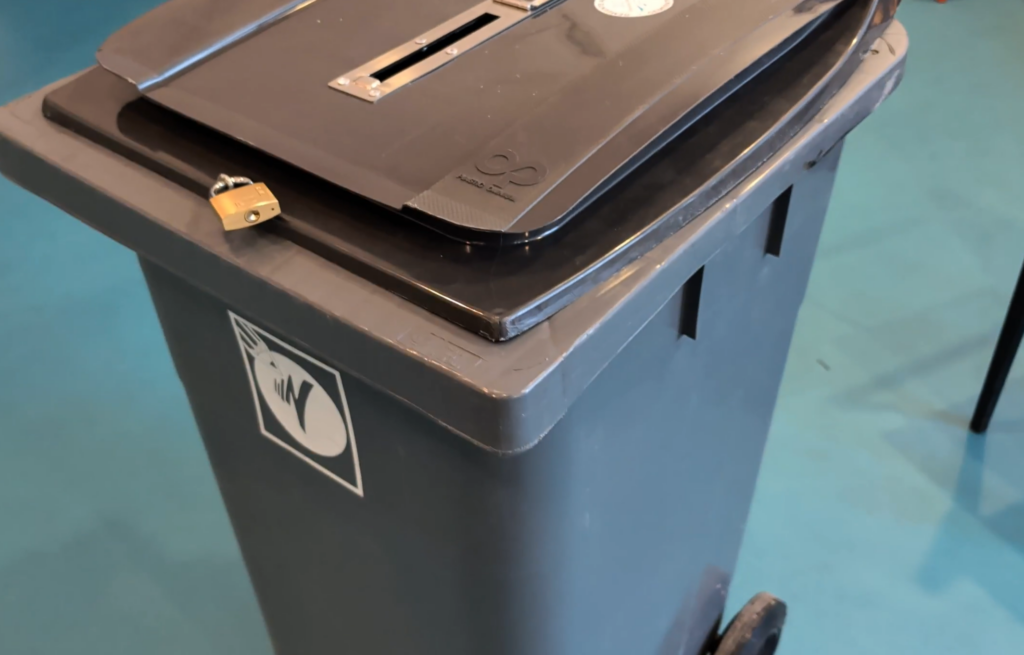
I visited the station, I handed in the invite pass and they checked my ID to make sure I am the right person casting a vote. Then they handed me a ballot paper. I headed to the voting counter, casted my vote on the paper and then dropped the paper in the “trash bin”. It was a very funny feeling that you drop your vote in a trash can.
Dropping your vote in a trash bin was the funniest part. If you feel like you want to waste your vote by not casting it, consider dropping it in a trash can.
And you are done. The entire process takes really short, and since the polling stations can be close by to your home you can just go for a walk with your children.
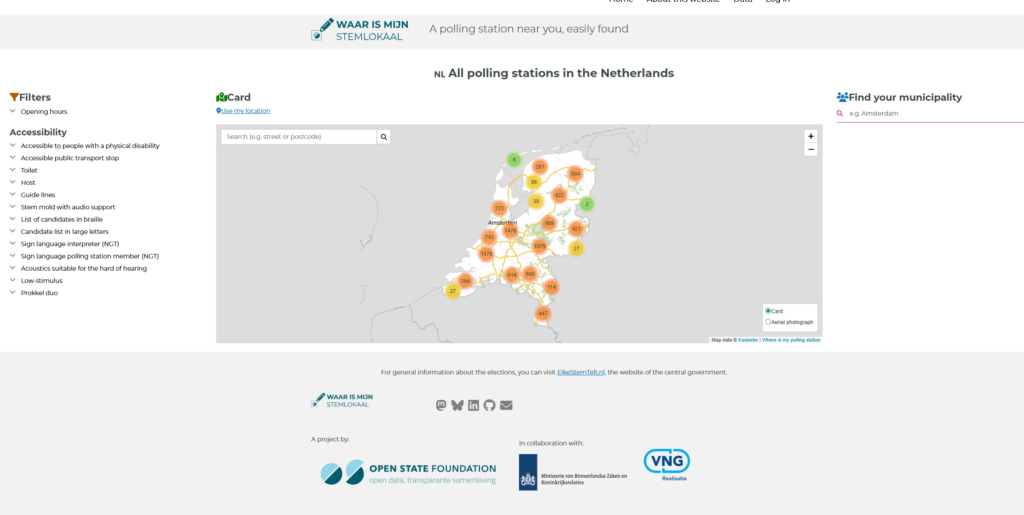
I found my closest polling station online, and it was less than 500 meters away from you. The website Where Is My Polling Station gives information about polling stations and you can simply find the station on the map.
You can find the polling stations that are closest to your home online.
The results take a few more time, but the results start to appear online and the leading parties are announced soon after the voting is done.
Be Responsible
While voting does seem like it does not really bring a change. The responsible thing to do is to cast a vote. Even if you cast a vote for someone who doesn’t have the biggest change on their agenda. If you believe in that person, go vote for them.
And for the winning parties, you have to deliver the dream you communicated.
If you use Wise to transfer money or even use Wise as a wallet for your money, you would need to rethink how to add money to your wallet. For the accounts in the Netherlands, iDEAL is a great way to transfer funds and make payments. Wise offers iDEAL as an integrated solution to transfer money between accounts.
I’ve been using iDEAL to add money to my Wise account and the main reason why I always chose iDEAL was:
Very simple and easy UI
Free of cost
While the core iDEAL service is still free and very simple. The ability to add money to your wallet via iDEAL is no longer free, and itis no longer a flat fee either.
How Expensive?
The amount you have to pay depends on the amount you are adding to your wallet. When you chose “External account”, you can add the amount you are transfering and then based on the amount you add a variable cost is shown. In the UI, Wise shows that the cost is not coming from Wise but from the underlying platform.
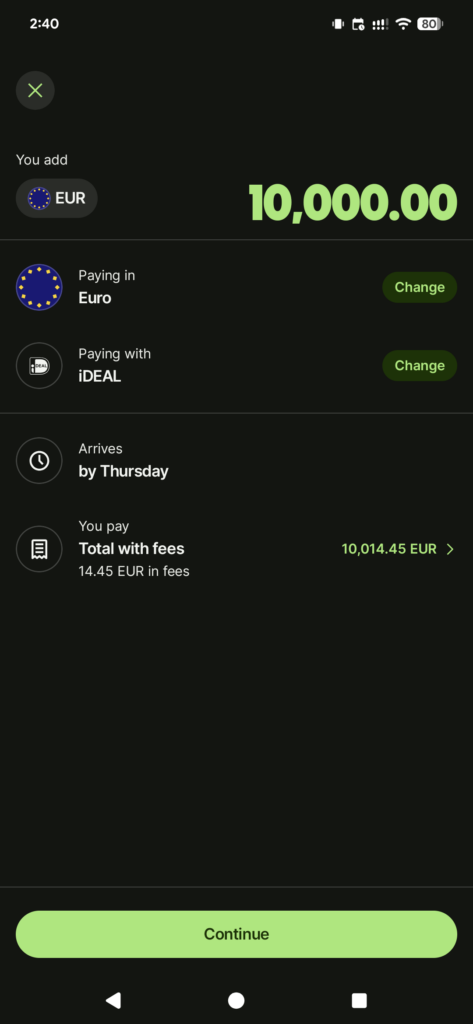
Here is a range of amount, fee, and total:
Amount
iDEAL fee
Wise fee
Total fees
Total
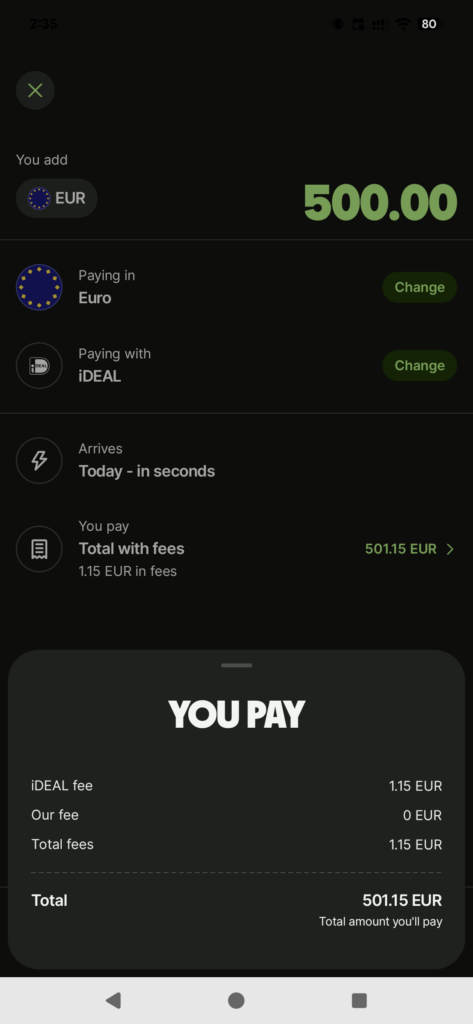
500
1.15
0
1.15
501.15
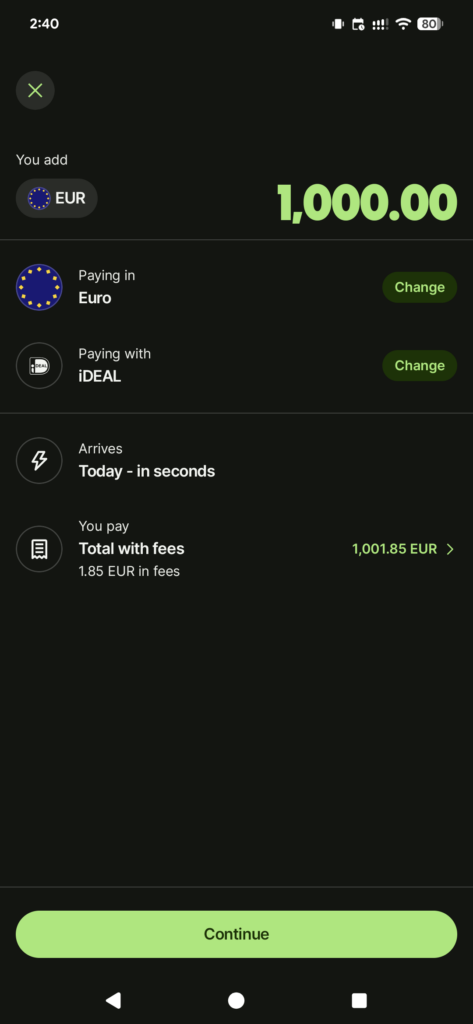
1000
1.85
0
1.85
1001.85
10,000
14.45
0
14.45
10,014.45
50,000
70.45
0
70.45
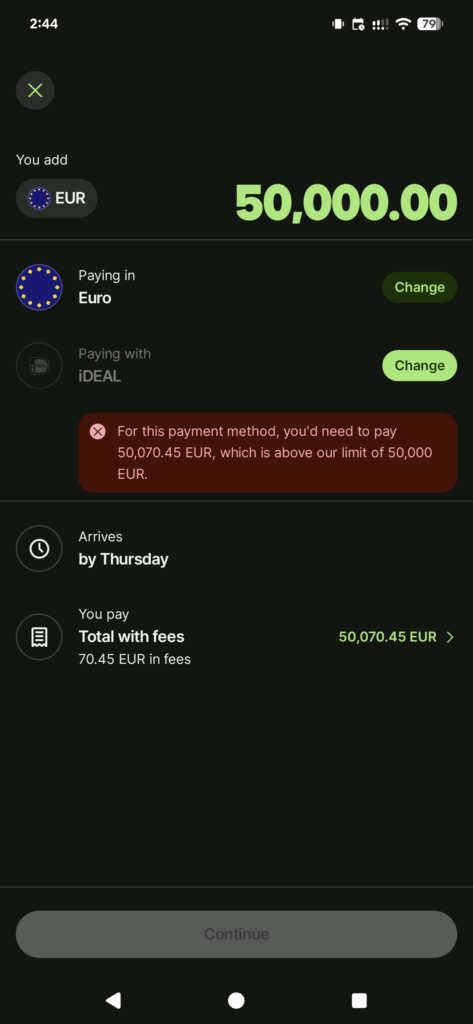
50,070.45
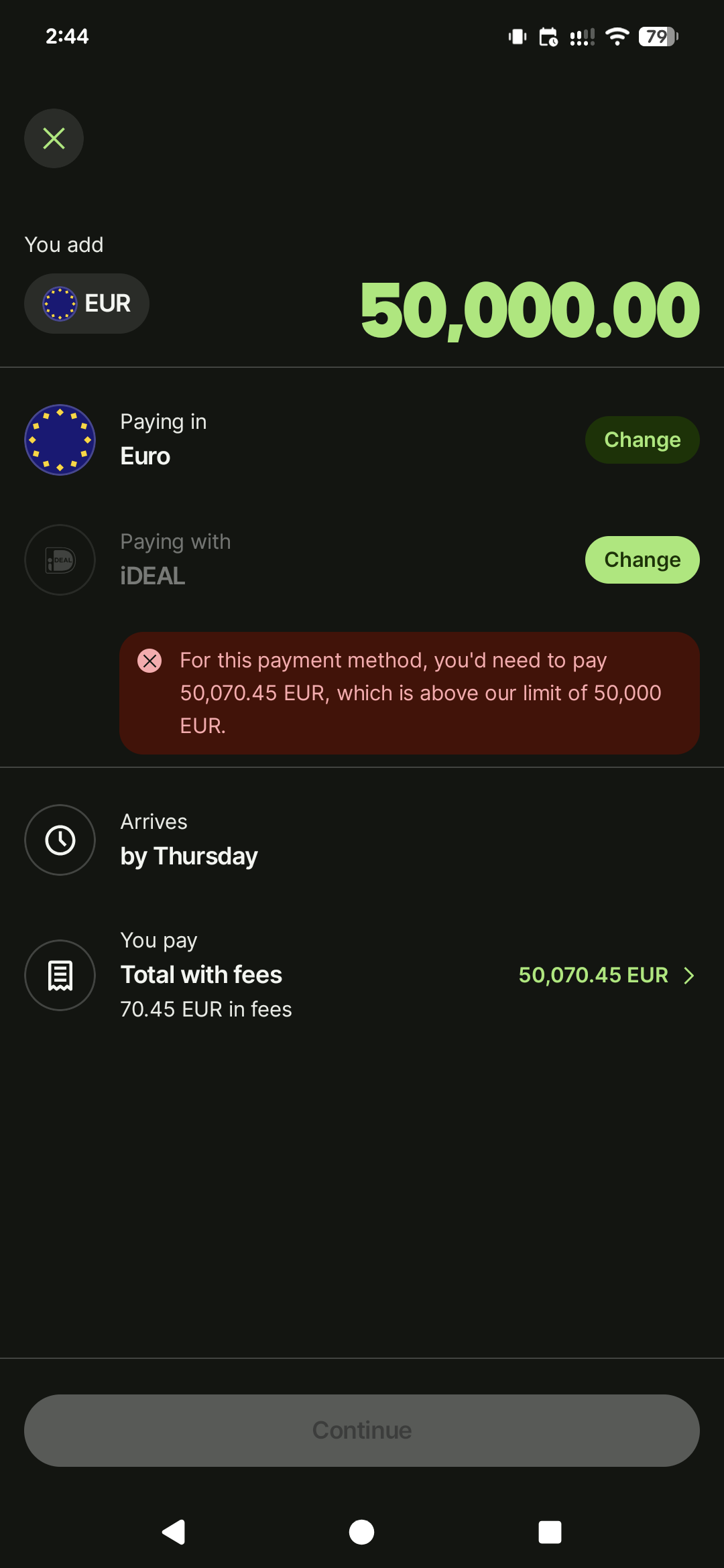
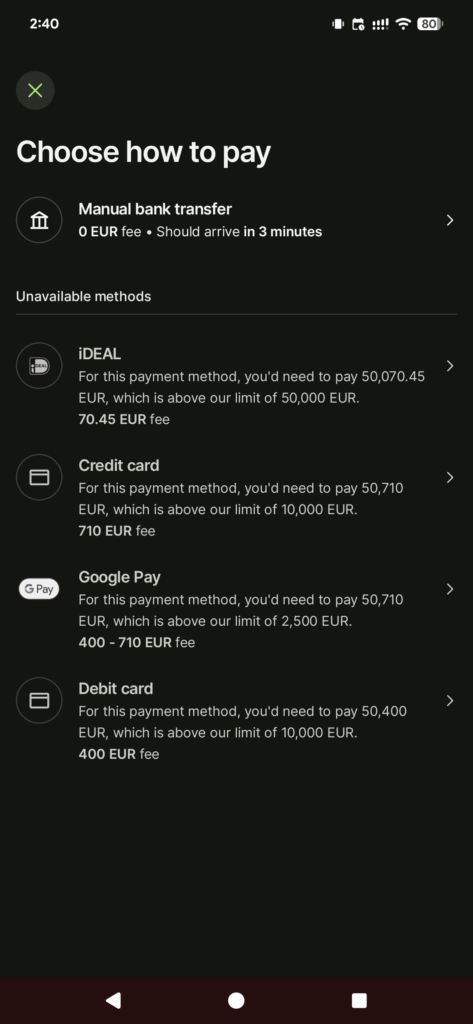
The amounts above are in euros. The maximum money that you can transfer using Wise is 50,000 EUR and this fee makes it impossible to add 50,000 EUR to your wallet.
Costs for adding 500 EUR to Wise via iDEAL.Costs for adding 1000 EUR to Wise via iDEAL.Costs for adding 10,000 EUR to Wise via iDEAL.Costs for adding 50,000 EUR to Wise via iDEAL.Alternative payment options available to transfer the amount to Wise wallet.
I’ve honestly used iDEAL to always transfer the amount, and while iDEAL still offers free of cost payments, perhaps their costs were increased to transfer money. I have no idea why this change was introduced–or who introduced this change. But, I am not a fan of paying extra; are you?
Alternative?
Disclaimer: This is neither a sponsored post nor an affiliate content to recommend any party. The content in this post is from my own experience of using the platform.
When you are adding money to Wise, you can transfer using various methods. One of the methods is bank transfer. Wise uses Tink service to connect you to your bank (via application or online) and you can transfer the money directly through your banks’s application. Safely.
Note how the regular payment methods are:
Extremely expensive.
Not fast enough.
Not available for big transfers.
As an expat, I do sometimes transfer about 5000-10,000 EUR, but not quarterly. And mainly only when there is an event or a plan. In such cases, every extra EUR counts. Look, I’m not against the fees. I understand the platforms also need to make money to pay for costs and expenses. But at least make some sense of the costs.
I haven’t actively used Tink, but I’ve transfered money via Tink a few times to Wise and the only hiccup is that it is a few extra clicks (taps) before you perform the operation and it takes a few more seconds before you receive the money in Wise wallet. Otherwise, sending 100 EUR and receiving 100 EUR is worth the extra wait.
A good resource to further read and learn about the Schengen visa rejection reasons can be found on this website (ticket2travel.world). In this post, I will not cover all the reasons for rejection because some of these can be personal and very serious. However, I will cover the most common reasons that they provide which are mostly because you did not provide good documents to support your travel or departure reasons. The notable reasons or the common ones are:
10. The information submitted regarding the justification for the purpose and conditions of the intended stay was not reliable.
13. There are reasonable doubts as to your intention to leave the territory of the Member States before the expiry of the visa.
So, you applied for a Schengen visit visa (maybe via the Dutch embassy) and your visa application was rejected because the visa officer was not convinced by your application, supporting documents, or other material that you are applying for the right visa category with the right documents. The visa rejection is not a red alert about you or your passport, it is just that based on your submission, you do not qualify for a visa. Once you receive the response, you have two choices:
Apply again with fresh set of application and supporting documents.
Appeal against the visa rejection decision made by the visa officer.
The decision you make does not impact the outcome you will have. You can receive a visa if you apply again (providing the right documents, and explaining the change in circumstances since you last applied) and you can get a rejection in an appeal if you still cannot convince the authorities or satisfy the requirements for the visa.
One example is: you say that you are travelling to the Schengen states to watch a football match, but your travel itinerary says you want to be in the Schengen states for 45 days, your financial situation does not support this, or you do not have work. In this case, the visa officer is likely to reject the visa application.
Note that your visa application is judged based on what you submit in the application (along with supporting documents).
Now, let’s fast forward, you’ve heard the bad news and you are ready to take the next step.
The easy way: Apply again
While a Schengen visa rejection decision can be appealed, it differs per embassy and country. Some countries have a transparent, easy, and smooth procedure to apply for an appeal, others, not so much. In all cases, you are always allowed to reapply. However, note that if you do reapply, make sure to:
Review, study, and understand why your visa was rejected in the first place. Mostly, a visa is rejected because a document was missing, your plan was not properly communicated, or you did not submit enough supporting documents to prove that you would leave the Schengen states before the expiry of your visa.
Apply with the supportive documents that you believe you missed or were not able to submit in the earlier application.
Clearly communicate to the visa officer that you understand why the visa was rejected, and what circumstances demonstrate a change in the situation or compel the visa officer to make a different decision this time.
Reapplying is a new application. You need to make a new application, submit all the documents (including the visa application) again. You will need a new appointment, pay for any visa application fees, and then wait for the new decision.
Since this is a new application, the decision can be either a Visa approved or Visa refused, and you will receive the rejection reasons again. If you receive a visa, then you will receive a stamp in the passport that you can use to travel to the Schengen states. If your visa is rejected, then you will receive the reasons why the visa officer is still not convinced by the documents that you have provided to support your application.
P.S. I have not yet created an outline for applying for a Schengen visit visa or how to sponsor your friends and family for a Schengen visit visa. I will update this blog once I have published the blog.
Now, with the visa application rejected again, you can attempt to appeal against this decision.
The other way: Appeal
Appealing a rejected visa application is a way that not many take. Appeal is your right if you believe that the provided rejection reasons are not grounded, and that you provided enough material to prove and demonstrate to the visa officer why you should be granted a visa.
Note: This guide is primarily for visas applied through The Netherlands embassy for a Schengen visit visa, mainly for friends and family visit. For other countries, a different procedure may apply and the rejection reasons document would provide more information, such as where, when, and how to apply for an appeal. You can read more about appealing your visa rejection on the IND website. You can read how you can appeal a Schengen visa rejection.
An appeal is an official request to have your visa application decision reviewed. An appeal can take up to 6 months of time. If you would like to travel urgently, an appeal is never going to help you. Only appeal for a visa decision review if you have about 6 months to travel, or you can travel after 6-7 months without any impact on the travel or the reasons to travel. In the Netherlands, the appeal can be made:
Directly yourself.
Your friend or family (if you applied for a friends and family visa).
A legal representative.
How to appeal?
You can submit an appeal directly to the IND and provide reasons for why you want to start the appeal procedure. IND will officially receive the application, and start the appeal procedure for your visa application. IND can provide you with further material that you can use to understand why the visa application was denied, and how you can provide supportive documents. IND expects further information, mainly written documents that prove the facts and statements. This can include any changes to the financial, personal, relational, social, or economic ties to your current country.
IND can request documents that they deem needed to proceed with the appeal. Once you submit the documents, IND takes the due legally allowed time to make a decision.
It is often a good practice to use a legal representative to start the appeal procedure with the IND. There are various reasons:
The legal council is more experienced in the immigration laws and can better convey your message to the IND in legal terms.
The legal council has most likely supported a similar client in the past and they know what the IND is expecting, and what you must provide to better support your case. Note that while you may think otherwise, every small or ignorable detail is important in making your case strong. For example, do you have social connections or responsibilities? They count.
The legal costs can be covered if you meet certain requirements.
The legal representative can also support you in making a decision (the final decision is always your own!). So, you end up making an informed decision and not a decision in haste. Especially, if you are going to wait for 6 months to hear back from the IND, you want to make sure you submit everything so that you hear the good news.
Visa approved
If your visa is approved, you will receive a decision from the IND stating that your visa appeal was found well and that the decision is now reversed. You can use this decision to reapply for a visa. When you apply with the letter from IND, you have to submit your passport and pay the visa fees.
The embassy will stamp the visa in your passport and return it to you. You can then travel to the Schengen states using the visa.
Visa denied
It is equally possible that the rejection appeal also fails and results in the appeal being rejected and visa rejection decision being sustained. This is indeed sad. But it is possible.
If this happens, you can proceed and have the appeal rejection fought in a court where a judge makes a decision. This is the next step and the judge can rule in your favor if your provide facts and supporting material, but the rejection can also be sustained.
A Schengen visa on your passport can mean easy movement between the Schengen states and visit Germany, The Netherlands, Italy, France, and other countries and be able to have that EURO Tour you wanted. A rejection can definitely shatter those dreams, but you always have a choice to reapply or appeal.
Did you learn something in this post? Did I miss something? Let me know and I can update the blog to reflect the needed information.
The Dutch are really good with English language and you can use English language as a way of communication across offices, schools, playgrounds, markets, and for regular life; with neighbors etc. You do not need to be fluent in Dutch to be able to live in the Netherlands.
You do need to learn Dutch if you would like to extend and convert your current temporary residence permit to a permanent residence permit or become a Dutch citizen through naturalization. At the time of writing this article, the current level requirements for the language experience is A2 for a permanent residence or naturalization as per the Immigration and Naturalization Service (IND).
Learning Dutch
If you have been learning German, then Dutch could seem quite similar to you at first. One of the major difference is the pronunciation of several words, and then, the several words, and the articles (Dutch language has two articles only 1/ de and 2/ het).
Dutch, while they are welcoming to speaking English with you, are even more welcoming to teach you basics of Dutch.
Tip: Even a Dutch person knows that it is difficult to speak Dutch.
Challenges
The biggest challenge learning Dutch is the availability and reliability of the English speakers. The Dutch quickly switch to English as soon as they realize that you do not speak Dutch. I have an experience where the Dutch person quickly switched to English to make sure that we are having the right conversation and the conversation is leading to the right direction.
I was taking a Dutch language course and after a few weeks the assignment was to place an order in Dutch at a restaurant. I went to a local restaurant that I really love and I tried to place order.
Me: “Voor mij, een portie friet”. The shopkeeper quickly switched to English and asked me, “What size?” I responded, “Klein”, he said, “Is this take away or for here?” I replied “meenemen”.
This felt very unnatural because I was making an effort to speak Dutch but the person was making sure that they are getting the order right, it would not be fun for them if they got the order incorrect.
Next, while this is not a major problem, but the Dutch “G” is a challenge to speak for many. Personally, as a native Urdu speaker, I do not find it difficult as we have a “خ” (pronounced: “Khay”) and that made it a very easy experience.
The Dutch alphabet is also easy, just a different pronunciation.
Opportunities
Learning Dutch is also very easy, and there are various opportunities for you to learn Dutch. In my experience, I used the following opportunities:
Speaking with neighbors, friends, and colleagues
Listening to radio, TV, paying attention to stations, announcements, etc.
Reading weekly newspaper, advertisement, and other Dutch material.
I always pay close attention to the conversations in the grocery stores (not like peaking into personal conversations) but to understand how the shoppers ask questions, what is the response, how do directions work, and more.
At the moment, the Dutch language experience requirement is A2, which is not hard. If you just read weekly material, have a conversation with neighbors, you are way ahead of your peers.
“Inburgeren” Experience
I took the A2-level Inburgeren exam here in the Netherlands — I took it in Amsterdam. The DUO exam center is in Overamstel, and you can book an exam online at inburgeren.nl.
The DUO exam center for the inburgeren exams for expats in the Netherlands.
The exam can be taken in other locations as well, but, prefer to find a location that is closer. A few pointers:
Always bring your valid ID card (passport, driver’s license, residence document) to prove that you are the person taking the exam.
Arrive at least 30 minutes before your exam time, this is to give you enough time to check-in, put your stuff in the locker, check your exam data, and be allowed to sit in the exam before the door closes. Yes, the door does close before time.
Ramp up your Dutch “cells” before the time, and practice before the exam day, not just before the exam.
Planning
Truth be told, I had been planning for the language exam since 2023 (3 years in the Netherlands) and at this point I could at least read and understand some words, at least listen to what they are saying.
I planned to integrate into the Dutch society for several reasons, including applying for permanent residence, but also to understand the society a little more, to be able to participate in the Dutch conversations.
Preparing
I am the kind of person who prefers to prepare way ahead of the exam, not just one day before the exam. Infact, if I do not know anything or if I feel that I am not prepared, I’d rather not prepare anymore. Opening a book, or reading the guides, right before the exam raises my stress levels, and I believe it would not contribute anything.
Think like this, what if right before the exam you learned a new formula or a sentence structure, when you get a question what would you do? Even if you know the answer, you may reconsider your answer because a new “fresh formula” is running in your mind.
Dutch inburgeren is not tough. The tough part is thinking like a Dutch. A lot of people try to cram the material or practice all 50 online practice exams, but that does not cut it. You really need to spend time in the culture, meet your neighbors, order food in local, read the paper, and pay attention to how people interact in the market, in the train, in work environment, and on the street.
The preparation for the Dutch inburgeren takes months, not weeks. But, the inburgeren exams, that is a different story and everyone has their own pace. For me, it took about 1 year.
Participation
I started my inburgeren exams back in 2023, and the objective was not to complete all the exams in one month, but to get an idea of how it would be like. I decided to take an exam, and reading made the most sense. I booked all the exams directly via the website and it costs 50 EUR per exam (when I did the exam, it was 50 EUR, the price may change).
I will add more details for each exam type and any tips as I collect more details and resources. Thanks!
One thing to note in the Inburgeren exam is, you are graded based on your understanding of the question. If your answer is perfect in grammar, but does not make sense as the right answer, then you do not get a grade. If you understand the question, you get half the points, and if you provide a perfect answer then you get the remaining half points as well. The “perfect answer” means correct use of grammar, right pronunciation, etc.
Listening and Reading
Like I mentioned, I took the reading exam first. I did the reading exam because I knew I can read Dutch, even if I cannot listen to it. The reading exam does not challenge you to produce the answer, rather it offers you a few choices that you have to use to decide which is the right answer. So, given all the information your task is to find what is the most obvious answer. I did IELTS a few years back and I had a small muscle to skim the text content and find the answer out of the options.
The reading exam was rather easy and simple, and I passed the exam. Since the exam takes place on a computer, and the options are selected on the screen, it is comparatively easy to evaluate the results and provide a grade. I was aiming for 8.
Passing the reading exam gave me the motivation to continue pushing and get done with all the exams. On the Listening exam, I repeated the same method. The exam is on computer, and you receive the results in 8 weeks (in practice, it is usually much faster, I got my results in a week).
I passed this exam as well. In one go. This motivated me a lot. And now I was ready to move on to the next. As a next step, I wanted to do writing, because it was medium difficulty but did not require me to learn about different insurances, benefits, and responsibilities.
Writing
Writing exam is a fun, but different exam. As the name suggests, you must write the answers to the questions.
Everyone is given a piece of paper that has questions on them and then you must provide a response within the bounds provided. You can cutout a mistake, but you must stay within the bounds of the answer field.
I only have one recommendation: stick to the question, and do not over answer the question. If they ask for your favorite dish, do not write down the recipe.
Writing exam also takes 8 weeks to provide a grade, I received my grades in about 5 weeks. I passed this exam as well, and I was now ready to proceed with the next exam. I decided to do KNM, as I was still scared of “speaking Dutch”.
Speaking
I did speaking exam at the last. The only reason why I was scared of speaking Dutch, and I was not comfortable “creating” sentences ad-hoc. I was able to understand, read, and even write a response back, but speaking was still challenging.
I practiced speaking a lot with my colleagues, and in the neighborhood before scheduling an exam. I took about 1 month to prepare for the exam and when I was ready, I just made an attempt.
Note: I made an attempt on an older version of the speaking exam. Now, the speaking exam has been updated.
The exam takes place on computer, and you listen to questions that you must respond to in Dutch. Some questions are singular questions (“what is your name”) and some questions are multiple, such as (“what do you like to eat, how do you make it?”) The multiple questions were very difficult because you have to think of two sentences and then merge them together using either “omdat” or “want”. I always used “want”. Do you know why? 🙂
The exam results take about 8 weeks, and I got my grades in about 6 weeks. I passed the exam. I was relieved that I now finally have the grades and a diploma for inburgeren.
Note: I did not do the labor market orientation, because I was working in the Netherlands and I could apply for an exception.
KNM
For me, this was the most challenging exam. The reason being, it demands a lot of knowledge and understanding of Dutch society, Dutch history, Dutch social security, work culture, and your rights, as well as the rights of others.
The exam is also multiple choice questions, where you select the right answer for the question. The focus is on how you would react in given situations as a Dutch person. This is why I recommend spending at least 4-6 months interacting with Dutch natives and understanding how they do things.
Learn about the social security, work culture, healthcare, childcare, family, housing, and other aspects of the Dutch society. History, education, and sports also play a crucial role in the exam and you should take a shot at learning more about that.
Free Resources
If you’re also learning Dutch, I’d like to share some resources that really helped me gain knowledge, insights, and experience in the language. Of course, these are only complimentary services and solutions. Use these along with real-world practice with your neighbors, classes, coworkers to learn how the native Dutch pronounce certain words.
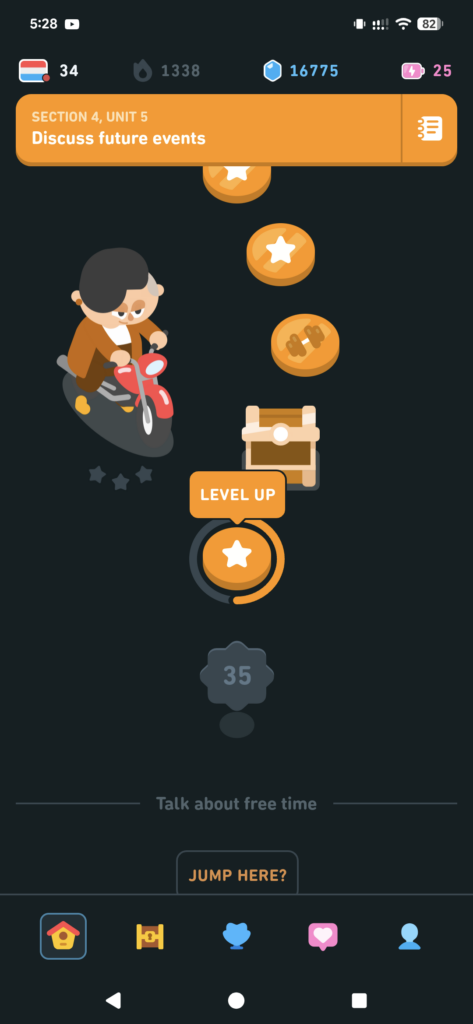
Duolingo
The first and foremost choice for many is Duolingo.
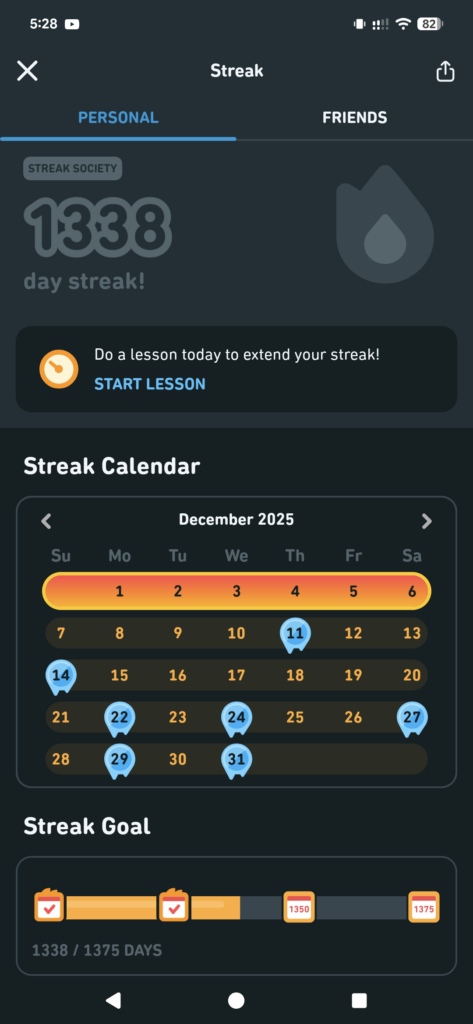
I have been doing Duolingo lessons for several years now, and I can vouch that Duolingo works in the long-term and not in the short-term. If you are attempting to clear the Dutch exam in a month or so, then Duolingo is not a good option for you.
Do:
Find a time when you will do a lesson each day. It is the best way to build up a habit of doing Duolingo.
Do one lesson, or a max of two, each day, and build up a muscle memory to pick up new vocabulary.
Do work with friends and coworkers, because one of the objectives of Duolingo is to offer gamified way of learning.
Don’t:
Overdo the lessons.
Don’t do tens of lessons each day, as you will be setting Duolingo on hard mode for yourself.
Just rely on Duolingo.
Dutch Grammar
This website gives you an idea about the Dutch grammar, sentence structure, and other parts of a Dutch sentence. The website is available free of cost, and focuses on beginner-friendly content.
I really, really, really love the material provided by the Groningen University Language Center. Check out their YouTube channel here. On their YouTube channel, they provide a lot of courses (playlists) for you to learn A2-level Dutch.
The content on the channel is free, and you can use language cafes and communities to practice the learnings.
Did I miss something? Were you looking for something else? Please let me know in the comments below, and I’d be happy to add more details to the blog above. I am still collecting all the details and experience that I had from my exams. I will update the post and add relevant information and tips.
Happy New Year, everyone. May this year bring blessings, happiness, joy, and luck to you and your family.
In this post, I am sharing the customs and the traditions of the Dutch and what I did–of course, I cannot take a cold dip.
New Year in the Netherlands
The Dutch really celebrate the new year, every year. And I mean, they really celebrate it. The top things they do, which, we can say are a cultural thing here now:
Celebrate with sweets; they tend to give gifts, and mostly enjoy Oliebollen. The Oliebollen are a type of donuts (doughtnuts), and is a Dutch delicacy.
Light up fireworks; this year alone the Dutch consumers spent over 129 million euros on fireworks. Which is a record high.
Take a dip; the New Year’s Dive is a traditional dip in the beach. The residents go to beaches and take a dip, but definitely, stay careful and vigilant. While the primary points remain the biggest beaches, such as Scheveningen, you can take a dip in your nearest beach too. There was an event planned in Almere Haven for the residents.
My New Year
I wanted to do something different. While the year started similarly, I decided to do a clean up of my street on the first day of the year. In Almere, we had a lot of fireworks and all that firework left a mess on the street. It has become a bad habit that people who enjoy the fireworks do not clean up after themselves. This trash is left for days and sometimes for weeks. The local municipality does the cleaning over the course of the next days, but that is too much work on their hands alone.
So I decided to give them a hand.
I started by cleaning the street. The objective was:
Clean and remove all the debris from the street.
Put the debris in a plastic bag and dispose of properly in a metal container.
It took me about half an hour. A little bit more, but after the half an hour, the street was clean. The debris was removed.
Fun fact: I had a neighbor stop me and tell me that it was not my responsibility, and instead, the people who used the fireworks or the municipality should clean it up. That is a very interesting take, and I respect it, however, if there is a delay or perhaps the authorities are busy, it can be done by ourselves too. After all, I call it my home so it is my responsibility to keep it clean as well.
Missed Opportunities
I still feel that I missed out on wishing everything a blessed year in my street. I could not connect with everyone on my street, and that would be on my list for the coming year.
For the neighbors, I would aim to deliver at least a wishing card to give greetings.
For the neighbors, that I have not had an interaction with, I will plan to have at least a coffee with them.
For the neighbors, that I have already met at least once, I would plan an activity.
The new year should give me a milestone to plan an activity and stay connected with my neighbors and community.
Summer is the Europe dream, and the winter is simply tough to plan for. In the Netherlands, winter usually starts around October with the rainy days, rainy nights, and cloudy skies making it difficult for even sun to say good morning.
My parents recently visited us here in the Netherlands and we wanted to take them out. The weather was wild, rainy, but the dine out made the day. All in all, it isn’t really the chills, but the fun bites that matter.
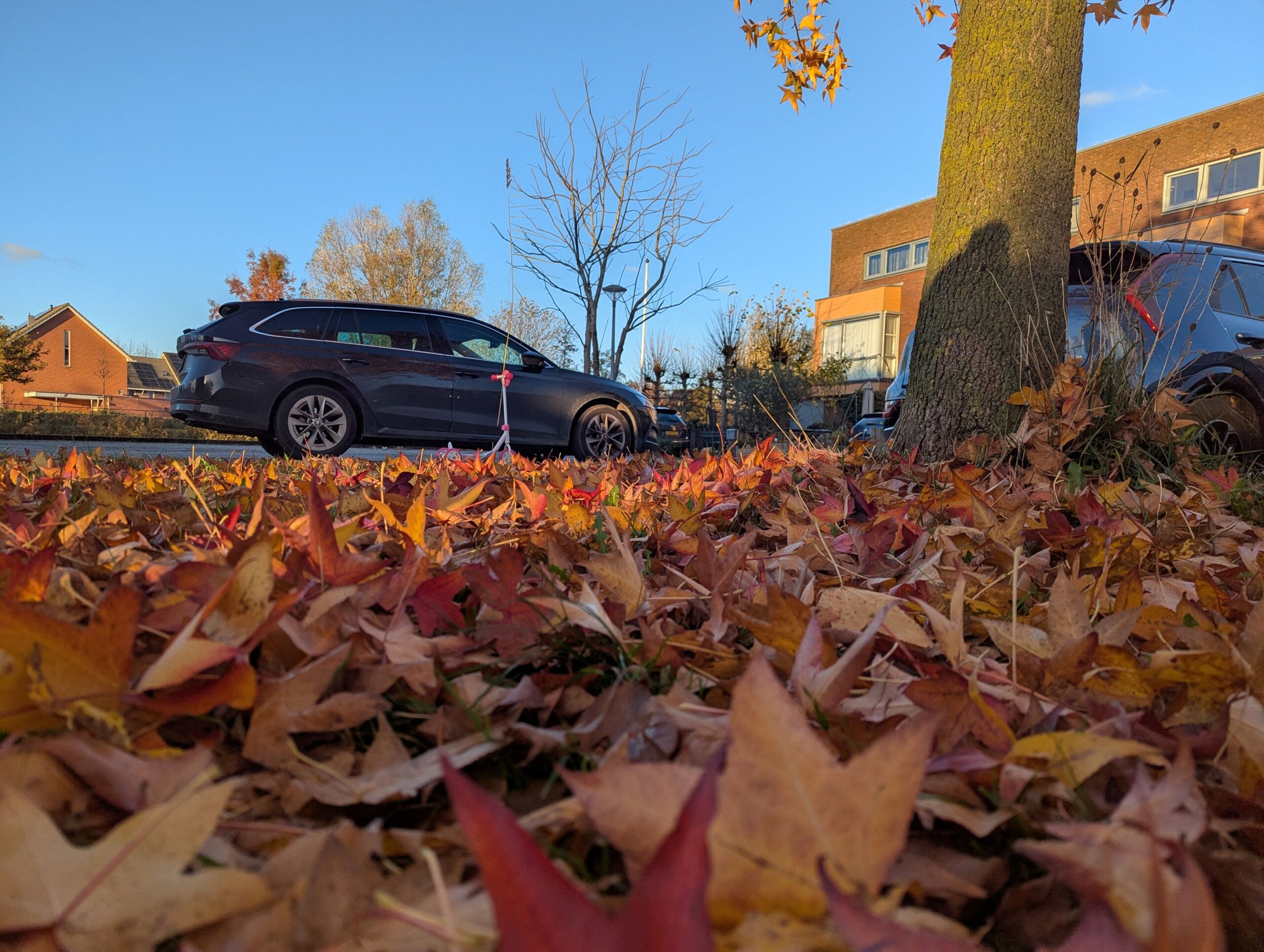
Autumn is very beautiful in the Netherlands, with fifteen shades of orange on the streets, a wet reflective surface on roads, and a calm and cool environment.
The leaves present a slippery but brisk way to walk across the street in the cold autumn weekends.
In the last 5 years here in the Netherlands, I learned the best way to deal with the winter is to spend time with people you care about, or who care about you. Go out for a walk, grab coffee together, watch the sunset, and tell a story or remember a memory.
The short days make it difficult to go for a long road trip, and the cold weather makes it difficult to enjoy the beach.
But, family, friends, they bring the warmth during winter.
Family dine out
We visited the Belqees Restaurant & Cafe — مطعم وكافيه بلقيس, and as always, really loved the family dine out experience. Even though we still call it “Yemen Restaurant” and love their “mandi”, they changed their name on Google Maps.
And that’s it for this blog, thanks for reading and watching. 🙂