This was my first time voting, and it was incredible.
Voting Process
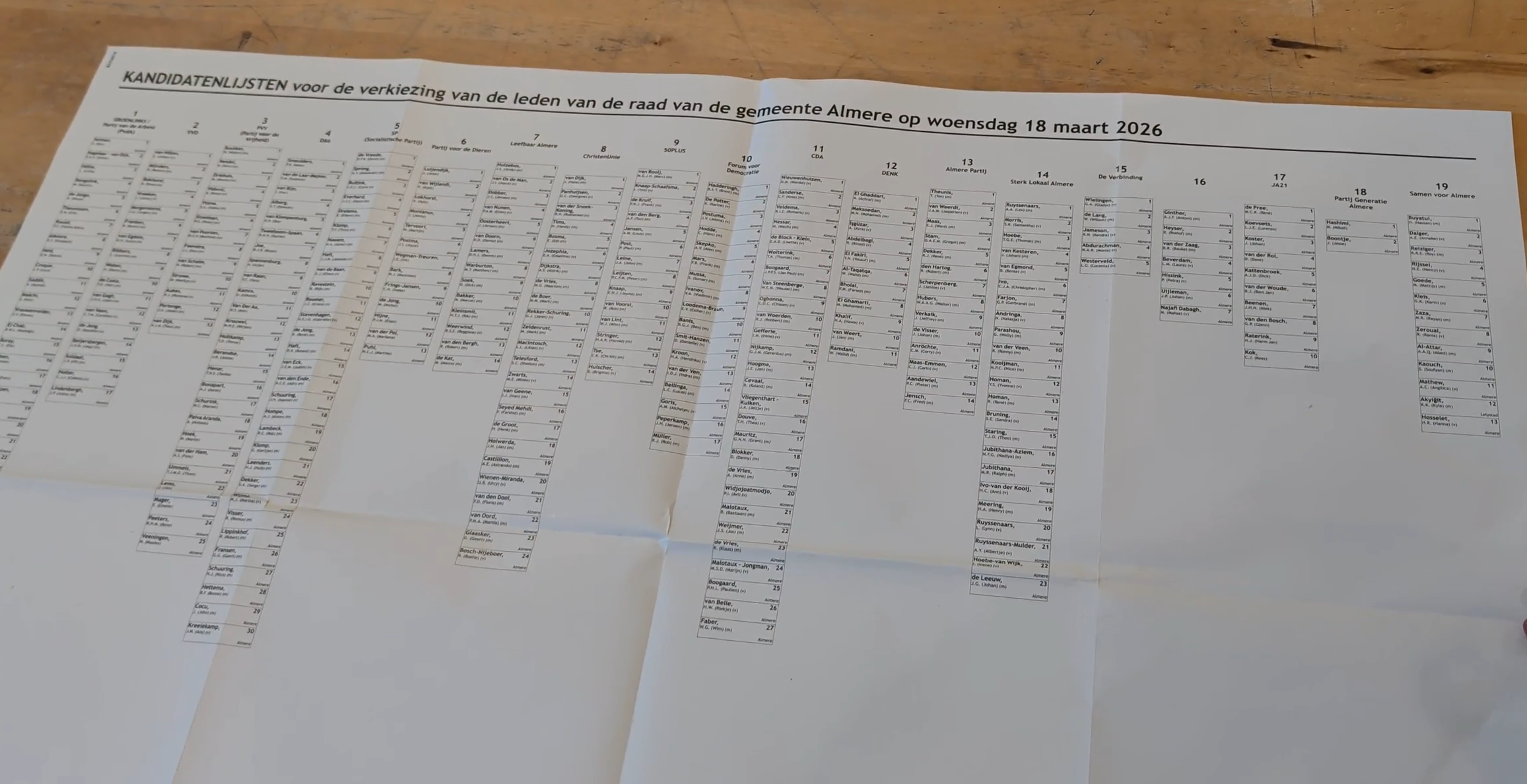
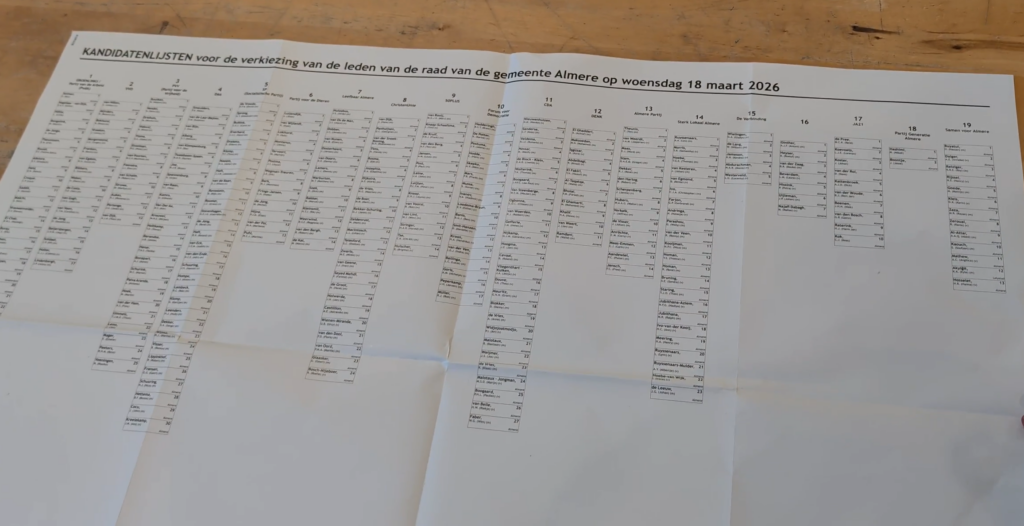
The ballot paper for the Almere council elections.
I am a Pakistani, and I do not hold a Dutch citizenship. And as per the laws, non-Dutch citizens are allowed, and invited to vote for the local municipal (council) elections. The rules are clear and simple, for non-Dutch citizens, adults who have lived legally for the last 5 years can vote.
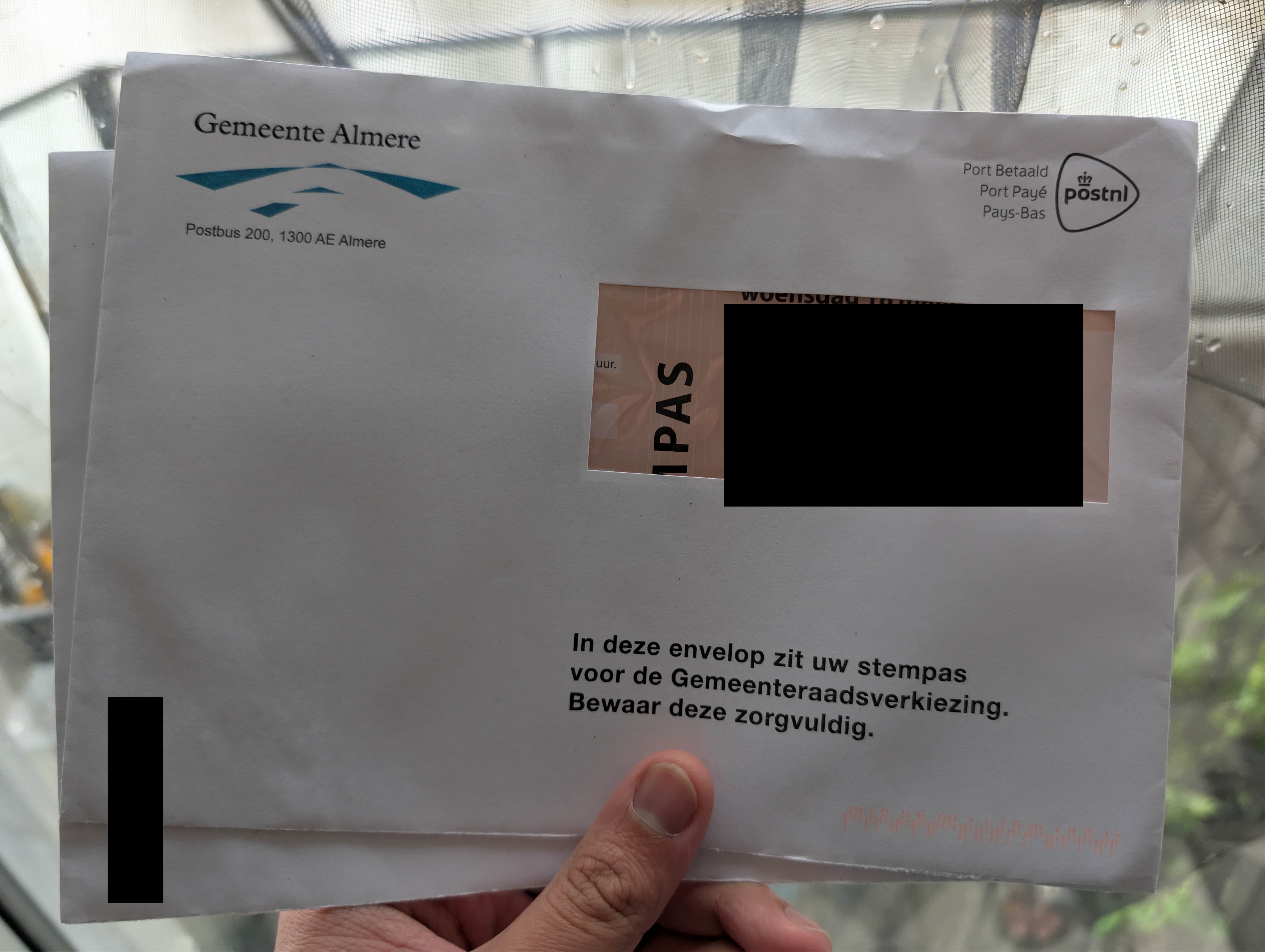
The invite is a voting pass that you receive, and if you are multiple people living at the address who qualify for the invite you will receive multiple invite passes.
The invite passes arrive to your home address a few weeks before the elections. If you do not receive a pass, or if you lose it, you should request a new pass from your municipality.
The election took place on Wednesday 18th March, 2026. The polling stations are open from morning until late at night (9pm in most cases). I visited the polling station after office, so about 6pm and it was a very simple and straight-forward procedure.
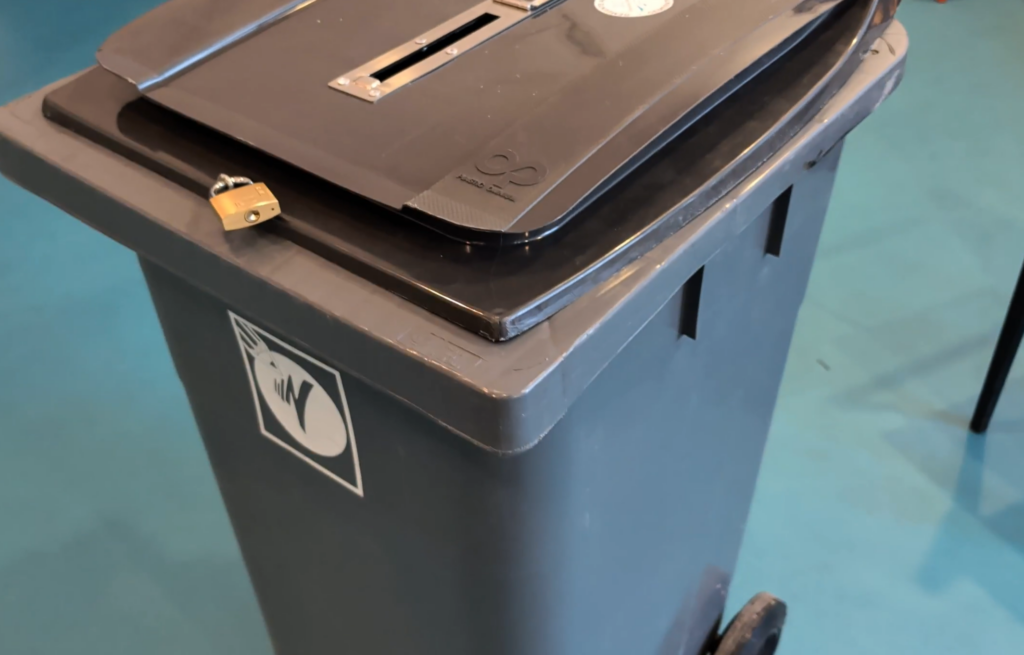
I visited the station, I handed in the invite pass and they checked my ID to make sure I am the right person casting a vote. Then they handed me a ballot paper. I headed to the voting counter, casted my vote on the paper and then dropped the paper in the “trash bin”. It was a very funny feeling that you drop your vote in a trash can.
Dropping your vote in a trash bin was the funniest part. If you feel like you want to waste your vote by not casting it, consider dropping it in a trash can.
And you are done. The entire process takes really short, and since the polling stations can be close by to your home you can just go for a walk with your children.
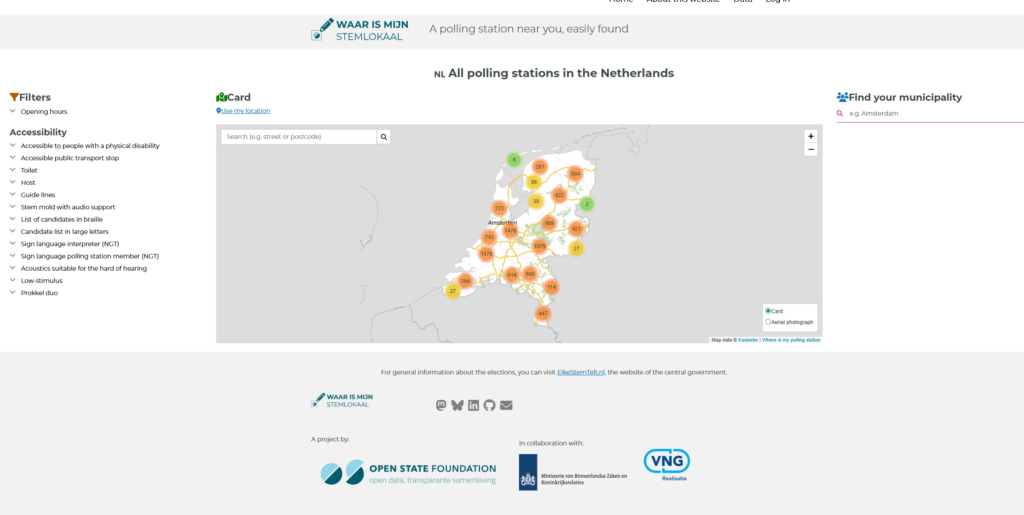
I found my closest polling station online, and it was less than 500 meters away from you. The website Where Is My Polling Station gives information about polling stations and you can simply find the station on the map.
You can find the polling stations that are closest to your home online.
The results take a few more time, but the results start to appear online and the leading parties are announced soon after the voting is done.
Be Responsible
While voting does seem like it does not really bring a change. The responsible thing to do is to cast a vote. Even if you cast a vote for someone who doesn’t have the biggest change on their agenda. If you believe in that person, go vote for them.
And for the winning parties, you have to deliver the dream you communicated.
If you use Wise to transfer money or even use Wise as a wallet for your money, you would need to rethink how to add money to your wallet. For the accounts in the Netherlands, iDEAL is a great way to transfer funds and make payments. Wise offers iDEAL as an integrated solution to transfer money between accounts.
I’ve been using iDEAL to add money to my Wise account and the main reason why I always chose iDEAL was:
Very simple and easy UI
Free of cost
While the core iDEAL service is still free and very simple. The ability to add money to your wallet via iDEAL is no longer free, and itis no longer a flat fee either.
How Expensive?
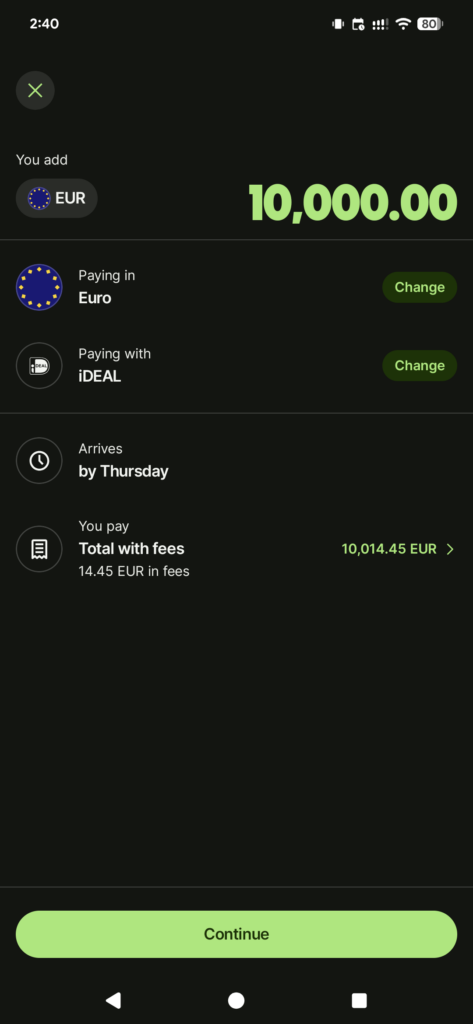
The amount you have to pay depends on the amount you are adding to your wallet. When you chose “External account”, you can add the amount you are transfering and then based on the amount you add a variable cost is shown. In the UI, Wise shows that the cost is not coming from Wise but from the underlying platform.
Here is a range of amount, fee, and total:
Amount
iDEAL fee
Wise fee
Total fees
Total
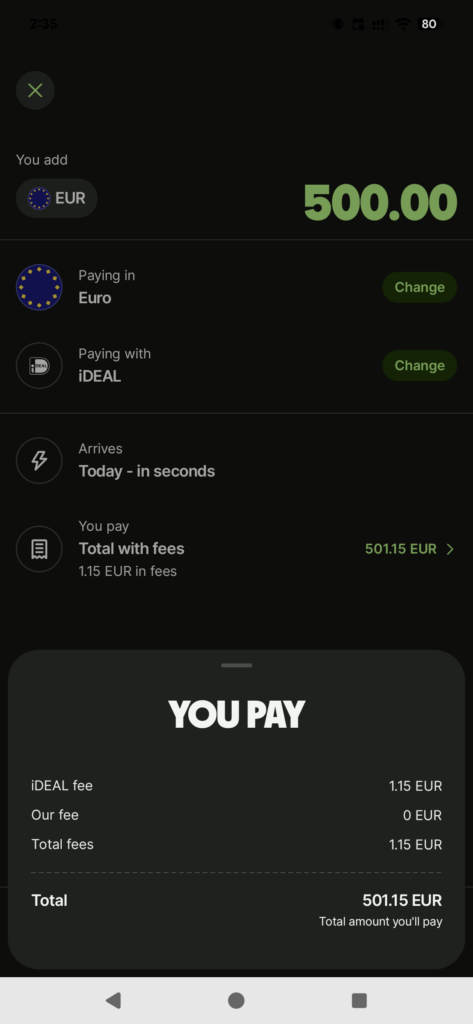
500
1.15
0
1.15
501.15
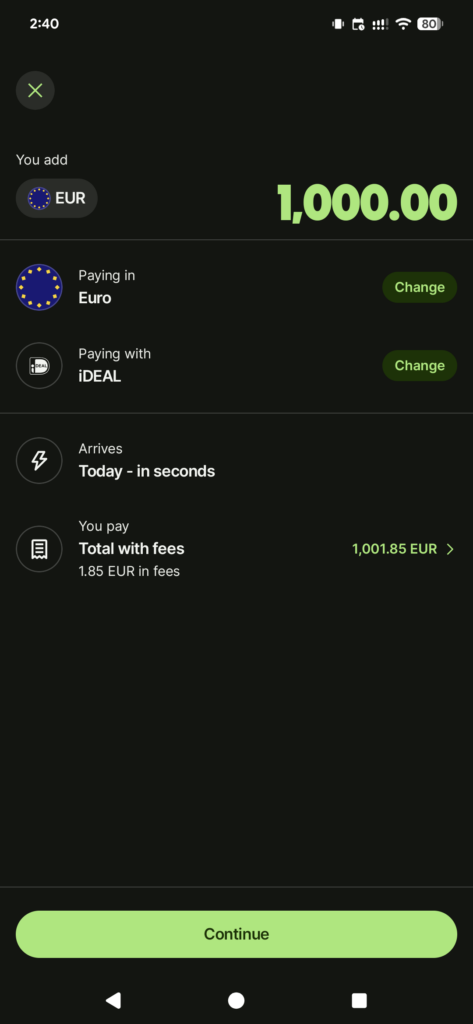
1000
1.85
0
1.85
1001.85
10,000
14.45
0
14.45
10,014.45
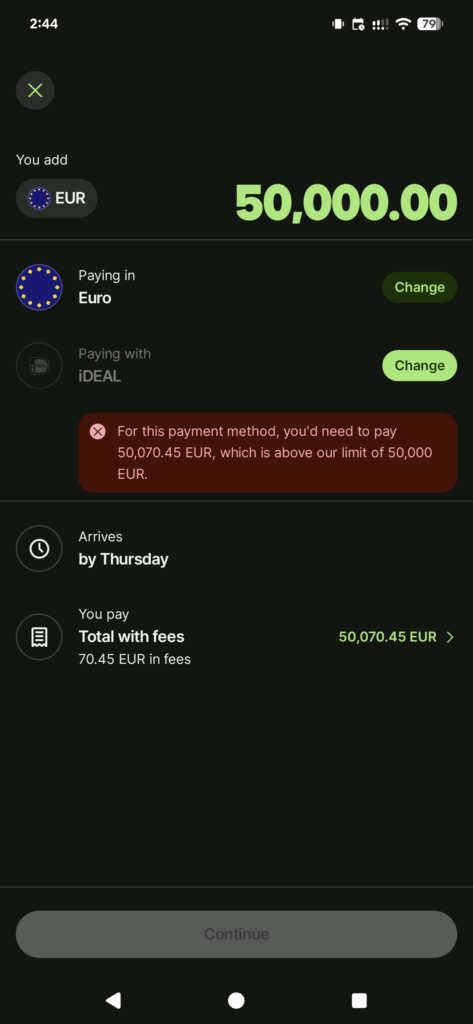
50,000
70.45
0
70.45
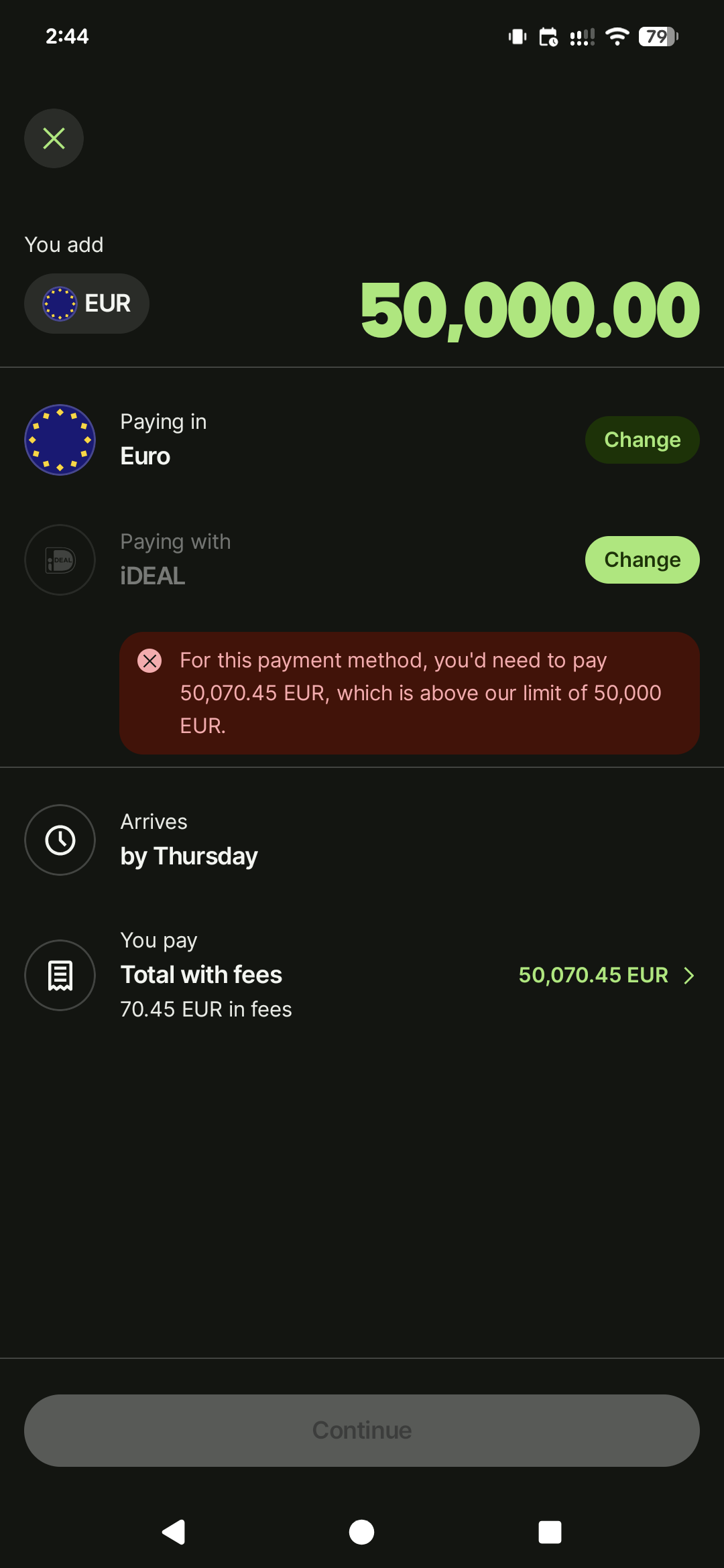
50,070.45
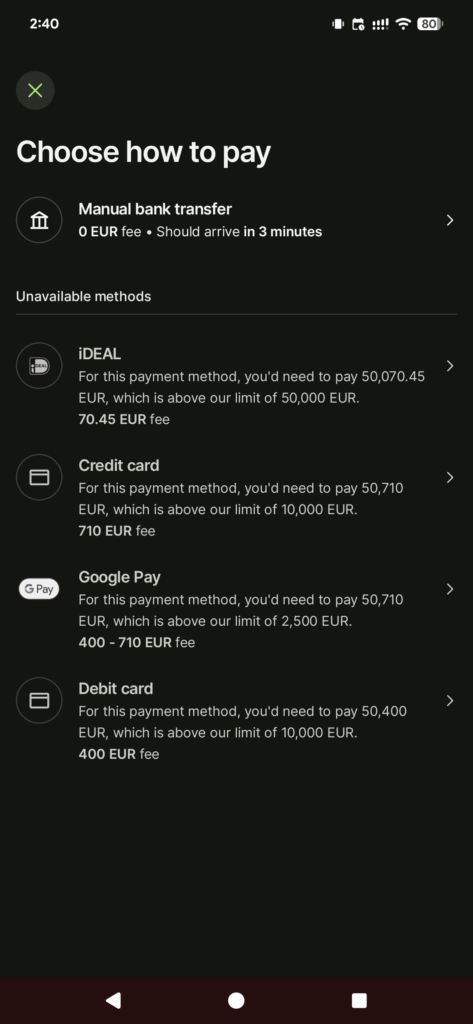
The amounts above are in euros. The maximum money that you can transfer using Wise is 50,000 EUR and this fee makes it impossible to add 50,000 EUR to your wallet.
Costs for adding 500 EUR to Wise via iDEAL.Costs for adding 1000 EUR to Wise via iDEAL.Costs for adding 10,000 EUR to Wise via iDEAL.Costs for adding 50,000 EUR to Wise via iDEAL.Alternative payment options available to transfer the amount to Wise wallet.
I’ve honestly used iDEAL to always transfer the amount, and while iDEAL still offers free of cost payments, perhaps their costs were increased to transfer money. I have no idea why this change was introduced–or who introduced this change. But, I am not a fan of paying extra; are you?
Alternative?
Disclaimer: This is neither a sponsored post nor an affiliate content to recommend any party. The content in this post is from my own experience of using the platform.
When you are adding money to Wise, you can transfer using various methods. One of the methods is bank transfer. Wise uses Tink service to connect you to your bank (via application or online) and you can transfer the money directly through your banks’s application. Safely.
Note how the regular payment methods are:
Extremely expensive.
Not fast enough.
Not available for big transfers.
As an expat, I do sometimes transfer about 5000-10,000 EUR, but not quarterly. And mainly only when there is an event or a plan. In such cases, every extra EUR counts. Look, I’m not against the fees. I understand the platforms also need to make money to pay for costs and expenses. But at least make some sense of the costs.
I haven’t actively used Tink, but I’ve transfered money via Tink a few times to Wise and the only hiccup is that it is a few extra clicks (taps) before you perform the operation and it takes a few more seconds before you receive the money in Wise wallet. Otherwise, sending 100 EUR and receiving 100 EUR is worth the extra wait.
I have a three-year-old. We never gave her a screen time until she was already 1 year old and even then it was slow-paced content that does not turn her into a zombie. Now, she knows how to play content via Google commands and it is often difficult to control her; but it was possible to control what she watches. Until about 4-6 months ago. The AI slop is destructive to your child’s development, brain development, and does not really teach your child anything.
I was watching content with my daughter when I realized that the content generated on this channel is actually extremely poor quality. Toby Town.
Disclaimer: I am not saying this is the only channel that has AI generated content (the “AI slop”), or poor quality content. There are so many examples of channels that generate content via AI and directly publish it to YouTube.
YouTube has recently started controlling and limiting the AI generated content, because, let’s be real. It’s plain stupid, lame, and sloppy. Sloppy on the content side and sloppy on the responsibility side of the creator. For me, the following three are the biggest concerns when it comes to the content. And before I share that, I honestly, do not care what my child (in a child-friendly manner) watches. If she wants to watch rock climbing, I’ll watch with her, if she wants to watch how to make buildings with magnetic tiles, I’ll buy a bunch of magentic tiles and build with her. What I would not accept is the content that damages her connection to the reality. And this is the outline or the boundary that I have set. So let’s take a look at why AI-generated content is wrong for your kids.
#1 Physically inaccurate behavior
Even in 2026, AI lacks a connection to the real world. AI does not know how objects behave in motion. Everyone is enjoying the ASMR videos of sun being cut into two, or how frozen nitrogen sounds when cut by a damascus steel made out of wood. When you read the statement, you can already picture different elements and know what is possible and what is not. If you are not able to differentiate between that from the sentence above, then perhaps, you can stop reading further. This article is not for you.
I gave Gemini this prompt and this is the video that it generated this video:
The Gemini-generated ASMR video lacks sense, but provides what’s asked and demanded.
For fun, it makes sense to have such ASMR content. But for the kids who are learning every second, this video does not really teach them. And if you overstimulate their learning experience with such “fake” content, it is damaging to their development.
A child is still in the learning phase, and they need to learn what is possible, what sounds are there, how mass works, before anything.
My bike teacher told me the perfect one-liner: it is easy to learn, but it is extremely difficult to unlearn what you have learned.
The videos demonstrate such movement that will not be possible in this physical world. The little brains that are just learning how the movement works, are more likely to be confused by the AI-movement than appreciate it.
#2 Auditory and visual coordination
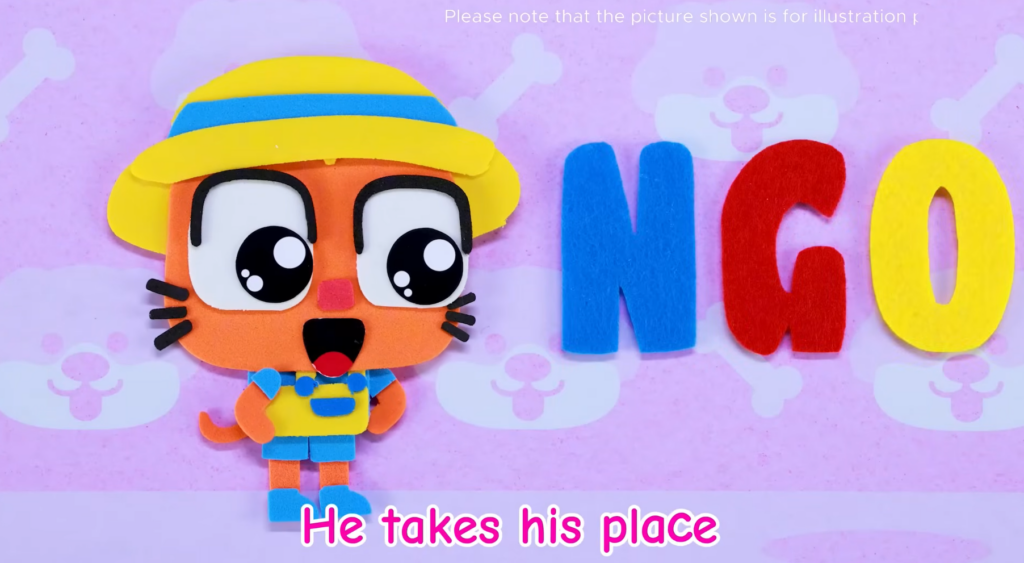
For starters, various videos do not have the audio and visuals match the scenario. The facial expressions do not match the emotion of the scene, the audio does not cue what may happen. Another problem is, time over time, I’ve seen videos where an audio and a video clips are merged together that do not belong together. Even if they are from the same publisher or creator, they do not match the on-screen behavior. A short example of this is, this video, where the on-screen content is a video about “BINGO the dog“, but the sound is about “boo boo song“.
The AI slop is sloppy because it is produced with quantity in mind and not quality.
The more you watch this content, the worse it gets. The captions say something else, the “speaker” sings something entirely different. There is a label on the top that again has nothing to do with the content on the screen. The content is a stop-motion animation.
And this is not the only example, this was actually the final straw where I decided that I needed to write this piece. You can look at this video and it shares the same story.
#3 AI doesn’t know how to cry
I have seen my daughter learn a lot from the content on YouTube. When I look at her building structures out of magnetic tiles, or when she demonstrates creating blobs out of clay dough, it makes me happy. I am happy that YouTube is a platform that can provide her a demonstration of “possible”. My daughter learned alphabets from YouTube, she sings along Ms. Rachel, she “claps her hands” with Super Simple Songs. At the end of a video, she has “done something”. Or at least she is building the neural network to be able to do something. The other day she was snapping her fingers at me.
AI-generated content will not be able to demonsrate this. You look at a child crying, or demanding something, and you can see there is a clear different between a child crying and a tantrum. AI content does not distinguish between these two.
Alright, so what to do?
When it comes to AI slop, I guess the only answer is to avoid it at all costs. It is not helpful for your baby, and honestly, it is not help for you either. Your baby will not only be watching content that is not real, the baby will have a hard time differentiating what’s real and what’s possible (think of objects flying through other objects, just because AI thinks that’s possible).
Today, AI-generated content is not limited to videos with generated persons but also for cartoons. These cartoons often do stuff that is not practical, but also not ethical. Since the person (or studio) generating this AI content has only one focus: generate more content. They have no time for quality control or review. Often time they ask AI to further review the content or make it compliant, which the AI does so by adding a label. Even the label does not conform to the content that is actually in the video. A simple label via the simplest video editor would take less time, but the person generating the content has no interest in doing so. Because they are so lazy.
#1 Track what your child watches
I have not given my daughter a separate account, she has a shared account that I can check the history of. I review the content, and I often set the content myself that she would want to watch. Here is how it goes:
Me: “alright, let’s put some video on the TV, which one would you like to watch?”
She: “that one” — as she points to a video with highest saturation in colors.
Me: “nope, that is bad, how about you watch either this video, or that video, or perhaps the last video you really loved?”
She: *thinks a little and makes a choice* “this one, this one”
Me: *plays the video and watches “with her”*
Note that the keyword is “with her”. I don’t put the video on and then grab my phone. I watch the content so that she finds it equally interesting.
Notice how one of the reasons why CoComelon’s videos are less advised for younger children because of the color saturation; YouTube video. In my opinion, it’s better to let your child bump to “baby shark do do do” than this AI-slop.
#2 Downvote the content
YouTube is also locking on to the AI-generated slop content so that they can reduce the number of times it appears. I have not seen useful AI-generated content, yet. The most recent interesting AI-generated (or at least CGI) video was this rollercoaster video that I watched with my daughter. It makes sense to have this CGI or AI-generated content for such scenarios and I am okay with that. The difference is that the CGI generated content is at least reviewed before getting published.
I always downvote a video that reflects the top 3 problems that I’ve listed above. Even though I still receive a recommendation to watch the video again (or another similar AI-generated video). Over the last few weeks, I’ve seen and shown no interest in several videos that often have similar content repeated.
The content, I’ve experienced, continues to reappear but you can continue to avoid and skip the content. YouTube algorithm is very complex, but the amount of slop that is being created can easily fool it. The problem is not that AI slop is being created, the problem is everyone thought it was an easy way to get quick views, subscriptions, and start earning on the platform. This greedy push for monetization flooded the platform with such content. In December, YouTube actually started to fight back on this AI content and a lot of creators saw their content getting less and less views, to a point where some videos are just getting zero views (check Reddit, I don’t mean to point fingers at anyone here).
#3 Have the “tough conversation.”
Our children do not stop watching or consuming content just because we told them. They really need to understand what is okay and what is not okay.
What really worked for me was first telling what AI was (of course, not the whole machine learning course) and then tell why this was not useful. I demonstrated some examples where a baby is sliding on mud and there is no scratch on the baby’s knees. After this explanation, I would give my child a choice that would make them feel in control and in charge. I would decide on the options and they will make a choice.
And like everything else, this is a repetitive approach and you would need to repeat this behavior again and again. The AI videos would continue to show for a while, but your child does not have to watch them.
Did you need to have a tough conversation with your child regarding AI? Honestly, this conversation has been the toughest one so far with my 3-year old. I had to explain what AI is, to explain why she should not watch AI-generated content.
This was it for today, I’ll catch you in the next blog. And if you read until this, I have something to share. I am starting a newsletter on this website and would be sharing similar content in a recurring cadence. If you found this content useful, would you consider subscribing?
Or, let me know what I missed. I’d appreciate that.